Straight Time/Swing Time
La ville du détroit is what the French called the place: “the village on the strait,” a fur-trading post beside a narrow, straight passage between two great lakes, founded in 1701 by a naval officer named Cadillac. One hundred and four years later, after the English took le Détroit from the French and the American colonists took Detroit from the English, President Thomas Jefferson sent an emissary there to serve as the Michigan Territory’s chief justice. By the time Augustus Woodward arrived, the entire town had burned to the ground after a barn fire, its six hundred inhabitants huddled beneath makeshift shelters.
Woodward—who fetishized all things Roman and Greek, and who’d written a book called A System of Universal Science to organize all the knowledge of the human race—did not see the burning of Detroit as a human crisis, but as an opportunity to impose his ideals of perfection and order upon a tabula rasa. Woodward stood on a high boulder with his surveyor and envisioned a new city rising from the ashes.
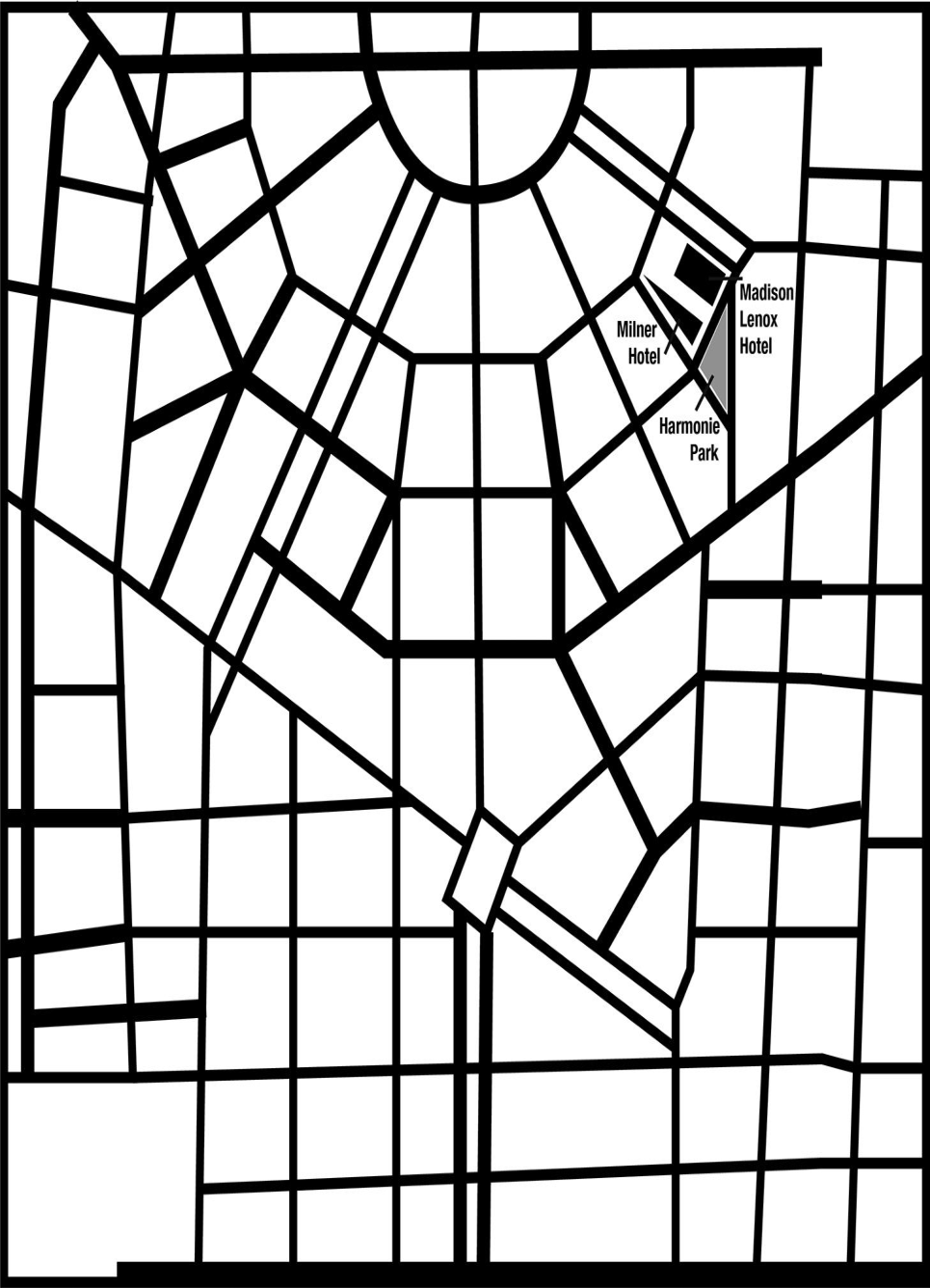
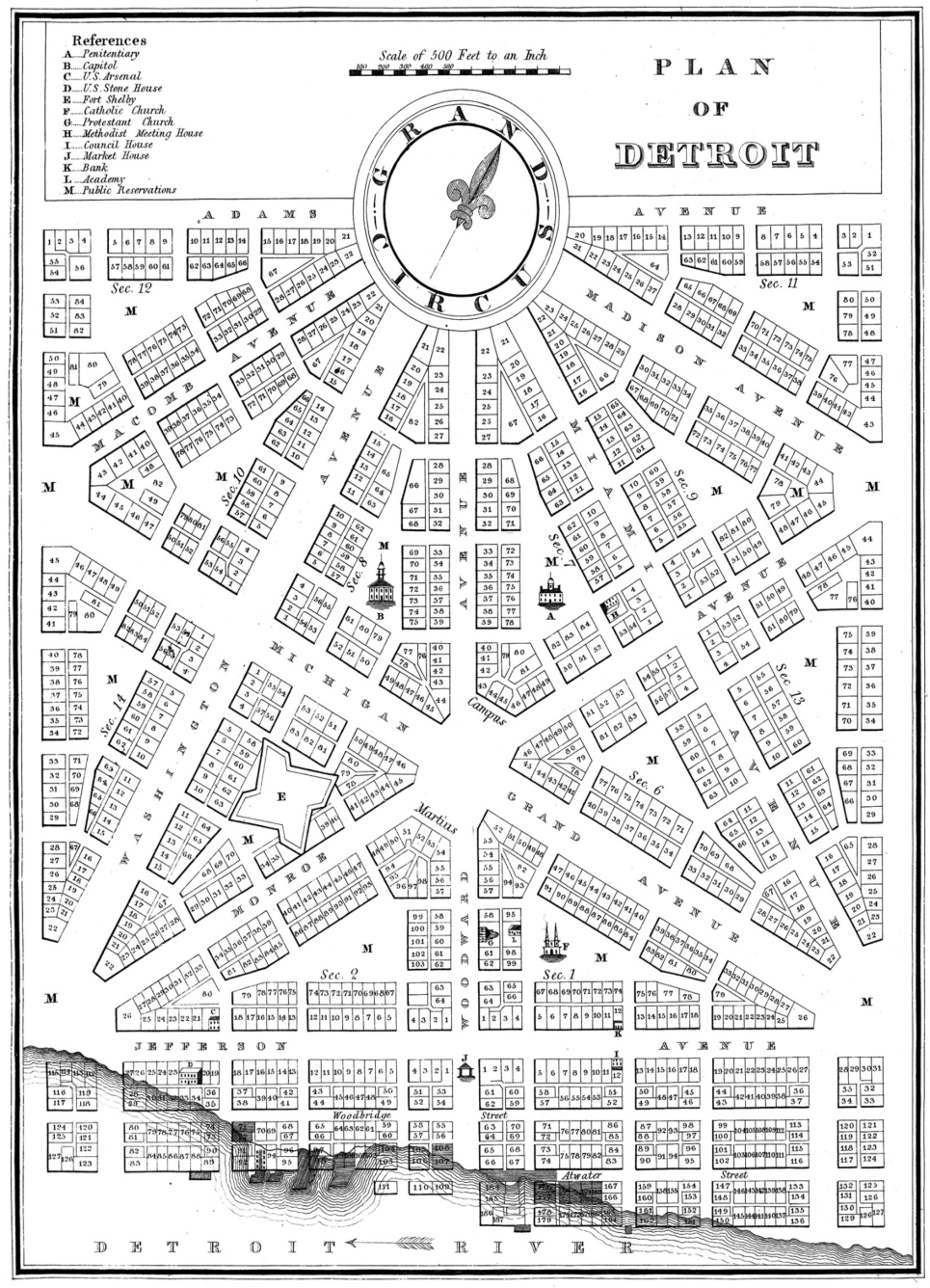
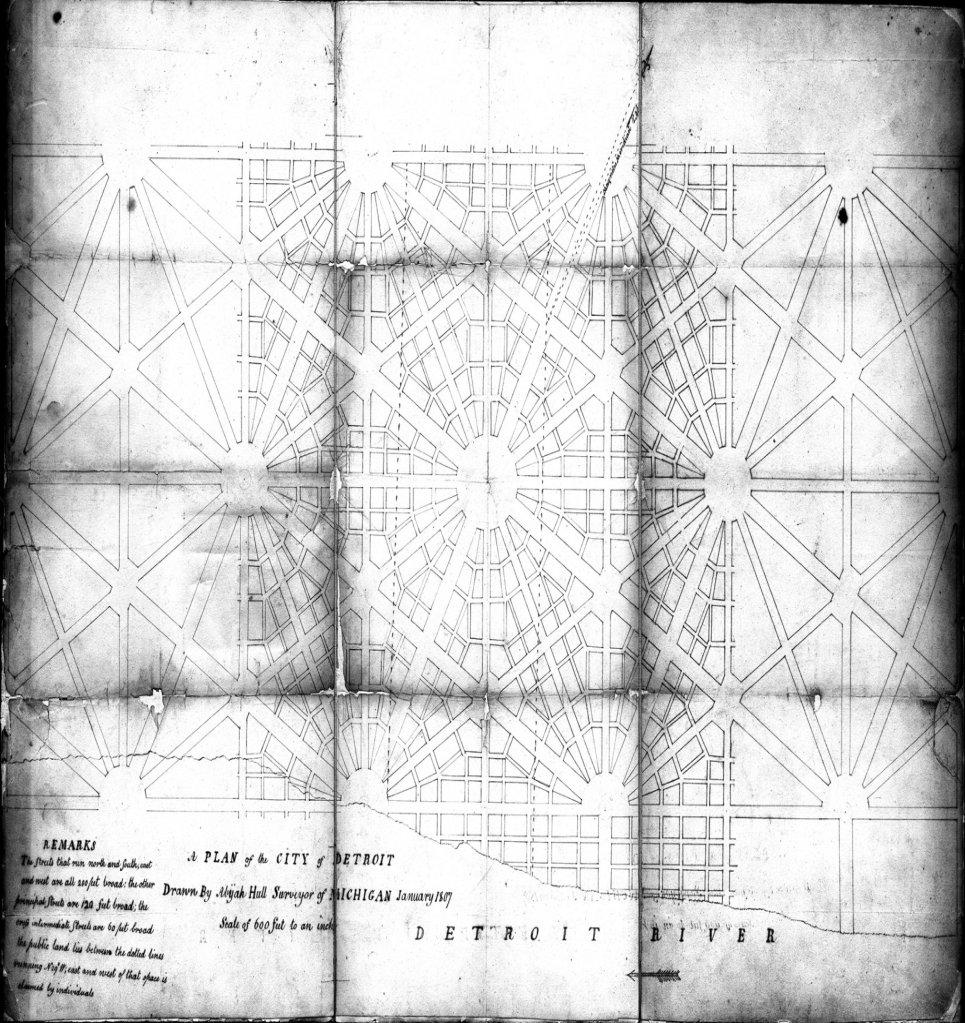
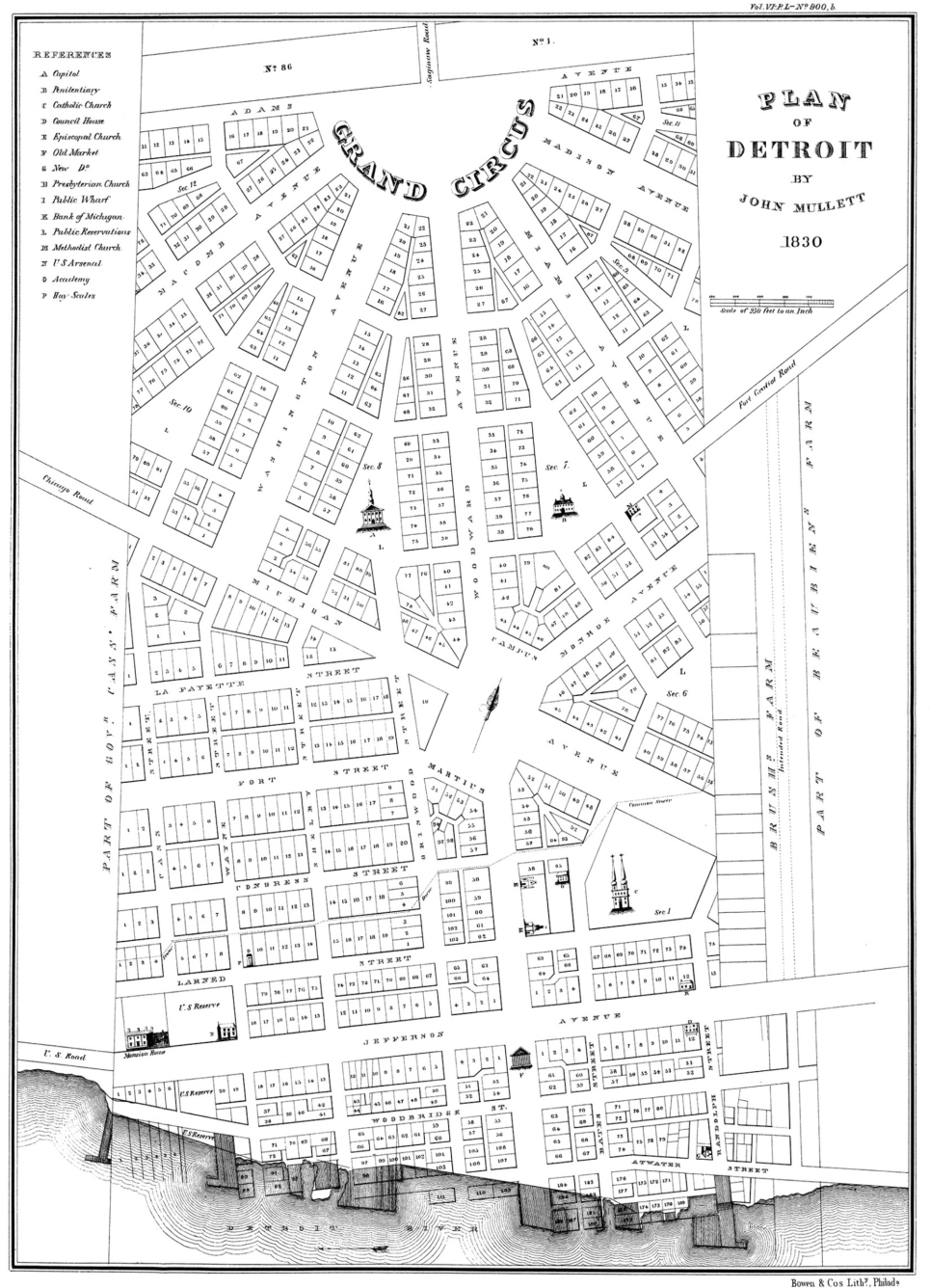
He drafted a plan of interlocking equilateral triangles, each side exactly four thousand feet long. He began with the first triangle, the base of which ran parallel to the river. At this triangle’s center was the survey origin point near his rock, which he saw as a military parade ground he dubbed in Latin “Campus Martius.” Six avenues extended from the central square. The three points of the triangle would be rounded out for other, circular plazas and parks, each themselves the end points for other, inverted triangles.
Woodward’s design for Detroit was among the first radial city plans in history. It was practical, allowing the city’s expansion simply by adding more triangles. And it was beautiful: elaborated on paper in 1807, the City of Detroit unfurled as a resplendent mosaic of alternating triangles arranging themselves into tiled hexagons; their interior avenues, circles, and rectangular campuses forming flowers of latticework. It was a design of rigid mathematics, in multiples of three, imposing its order on the American landscape and upon everybody within it.
Imposing order, their order, was an obsession for the Europeans before and during the colonial enterprise. European cultures had developed precise rules for everything: in architecture, and in music. Some musical rules were governed by physics—for example: a vibrating length of string, cut in half, will produce a vibration twice as fast, resulting in a tone that seems to the human ear the same as the first, but higher in pitch.
But almost every other European “rule” about music was really a choice. The reason that the above phenomenon is known as the “octave” is that Europeans decided to devise a system making that higher tone the eighth step on a scale of seven degrees or notes. Europeans created a second tonal system, dividing this same distance into twelve smaller, equidistant steps. Again, a choice. Those choices—the seven- or twelve-note scale over even rhythms counted in multiples of either two or three—evolved over hundreds of years into a common practice that determined what Europeans would hear as musical and what they wouldn’t.
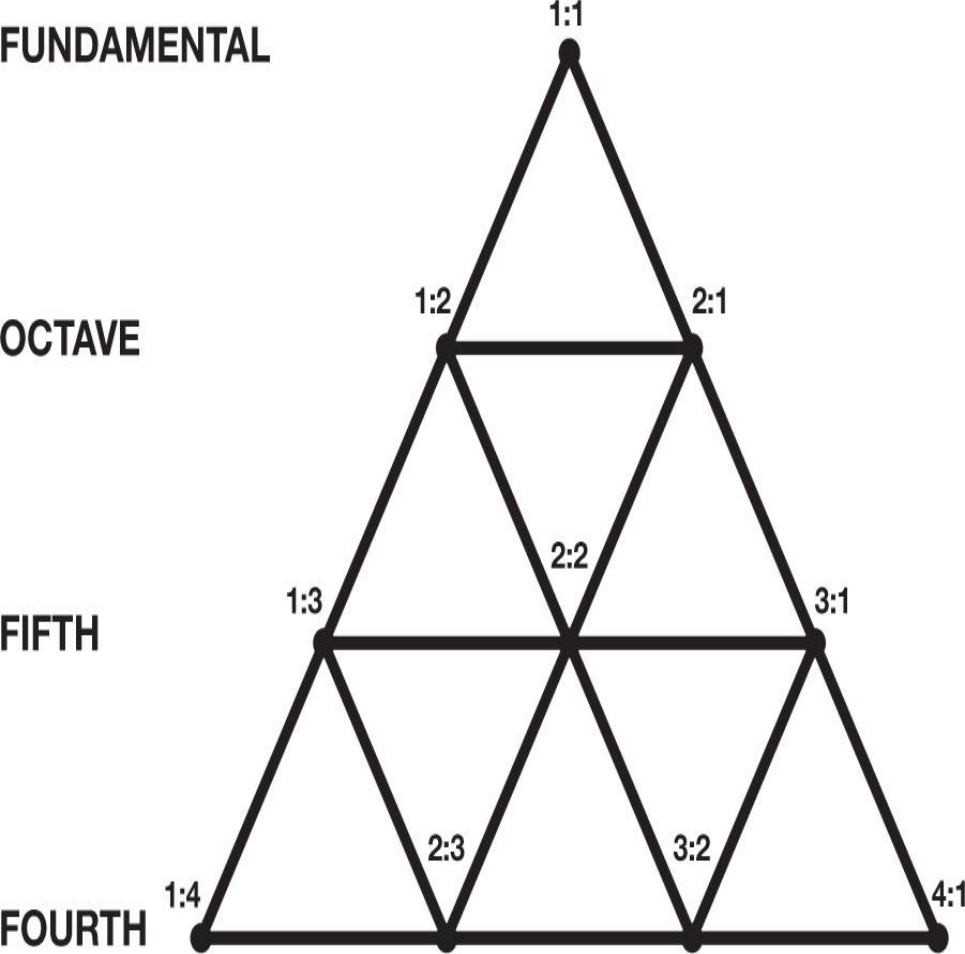
But there were other ways to conceive of music. The Greeks, much earlier, had devised a ten-tone triangular system of harmony called the tetraktys . Asian cultures divided the distance of an octave into scales with five, seven, twelve, twenty-two, and fifty-five steps.
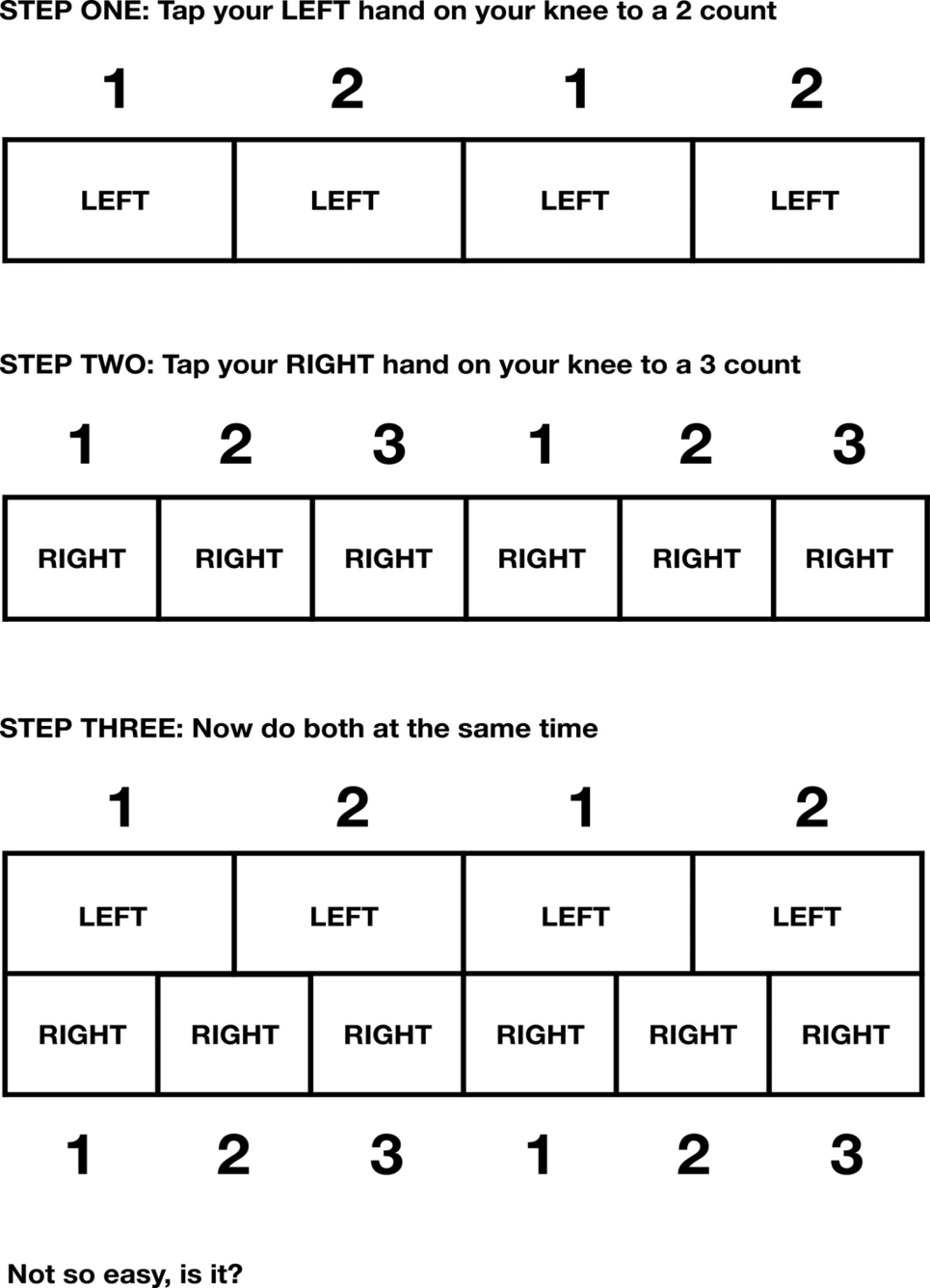
African performance was less formalized and more participatory than the European system. The African concept of pitch was much more granular, what we now call microtonal . And Africans evolved a more complex rhythmic sense, wherein two different pulses were often laid on top of each other, played simultaneously, called polyrhythm; for example, a chunk of time counted in twos and threes at the same time . Polyrhythm was the sound of two or more strands of rhythm happening at once, at seeming cross-purposes to each other, but part of a whole.
Our musical expectations are governed by where we’re from. Pitting twos against threes in this manner was foreign to the European practice.
What the Africans heard as music, Europeans heard as wrong, alien, uncivilized. When the Europeans came to impose their will upon the Africans, these cultural biases played no small part in their justification for what would become the most atrocious imposition in human history, the transatlantic slave trade.
The calculus of colonizers met new realities on the ground, and their schemes often yielded unintended consequences. The citizens of Detroit hated Woodward and his perfect plan, as did Michigan’s new governor, Lewis Cass. So they sabotaged it. Cass sold off new lots north of Woodward’s first triangle, blocking the plan’s inland expansion and decapitating the top half of what Woodward envisioned as “Grand Circus Park,” henceforth only a semi-circus. French farmers on either side of town sold their lands piecemeal, blocking the paths of many crosstown roads, their borders becoming long streets that preserved the farmers’ names—Beaubien, Campau, Moran, Chene. City merchants and politicians decided to ignore Woodward’s plan for the bottom of his triangle and developed it on a simple gridiron of streets at right angles to each other, the linear twos of the merchant class wedging a ragged interruption into the graceful rhythm of Woodward’s baroque threes, two things happening at once, at cross-purposes to each other. A polyrhythm of conflicting intentions.
Try it yourself: MONORHYTHM/POLYRHYTHM
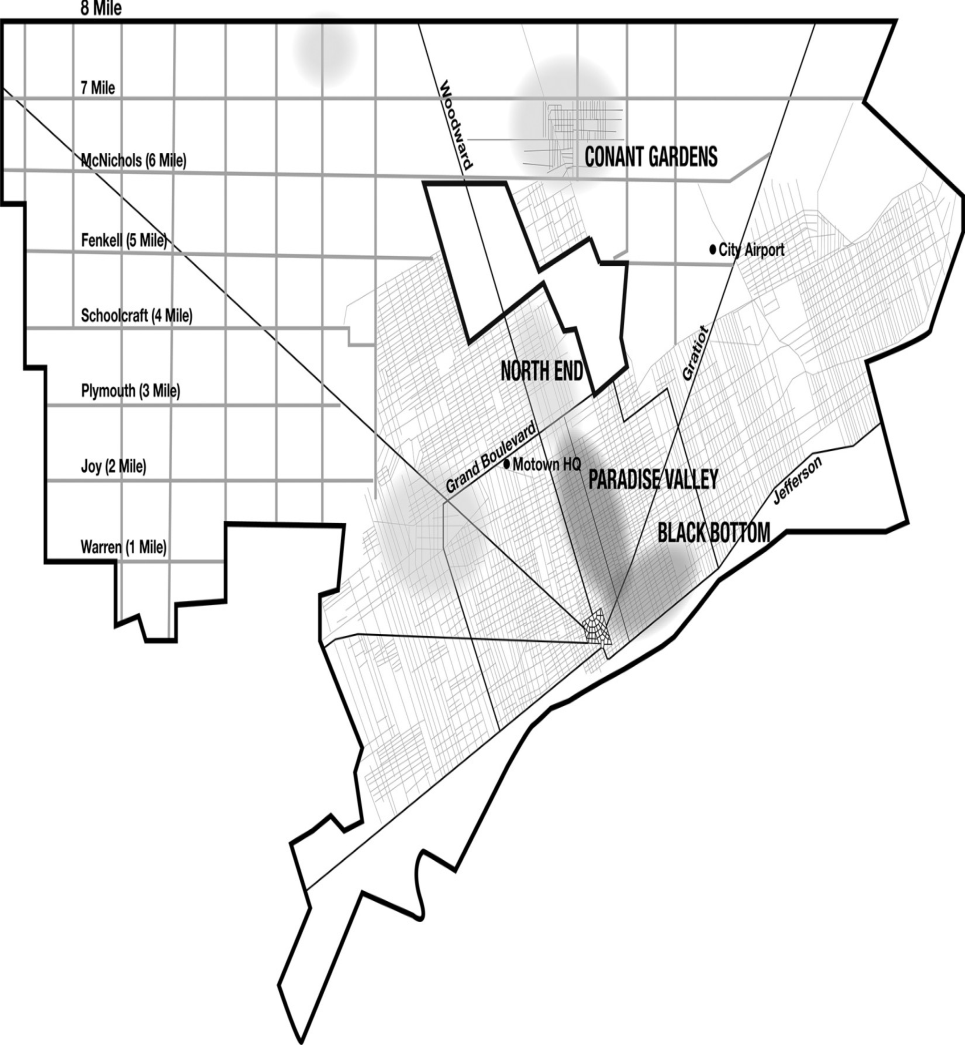
Thomas Jefferson’s Land Ordinance Act required another grid, aligned with true north, an act of violence upon the land presaging another on Indigenous people. In Michigan the borders of these grid squares, measured in miles, came to be defined by roads running in long straight lines with no regard for topography. As Detroit grew, these became the “Mile Roads” that ran east to west across the city, conflicting with the crosstown roads that ran parallel to the river. Now Detroit had two, misaligned grids. Wherever Detroit didn’t name the mile roads, it numbered them by their distance from Campus Martius. When Detroit eventually finished expanding northward, it set its border at a road called “8 Mile.”
Little remained of Woodward’s vision in downtown Detroit: fragments of three triangles, like shards of an artisan’s elegant tile, shattered and forgotten. Six broad roads exited the city like disjointed spokes. The street that would have been the bottom of that triangle, Woodward named for his benefactor, Jefferson; and the street that bisected the triangle, he named for himself, though he later claimed that he called it “Woodward Avenue” only because it ran toward the woods . That road became the central axis of a city where the streets on the west side didn’t match up with the streets on the east. Some zagged in odd places and others dead-ended. Others were built in broken sections. In the city on the strait, nothing would be exactly straight.

Woodward and Jefferson were hypocrites: fans of grand plans with fatal flaws; peddlers of platonic ideals they didn’t practice; prophets of freedom who owned slaves. They wouldn’t live to see the disorder their order created.
After Europeans abducted Africans and took them across the Atlantic, African men and women had to disguise their religious and musical practices in order to preserve them. In South America and the Caribbean, African gods were rebranded under a Catholic veneer, so African polyrhythm persisted within it. [^1]
But in the Protestant English colonies that became the United States, religious practices from Africa were forbidden, and polyrhythm vanished.
Musical expression outside Christian hymns was suppressed; drumming, especially, was seen as clandestine communication and tantamount to insurrection. Wherever the African retentions and inheritances surfaced, they did so most often in a European frame: the seven-note scale, but breaking the rules just a bit; the performance word-for-word and note-for-note, but deviating just a bit. In North America, the greatest African inheritance—that polyrhythmic sense—was restrained by the European practice of one even pulse counted in either twos or threes, but never both at the same time. How polyrhythm began to peek out, just a bit, is in a phenomenon called syncopation .
Syncopation is what happens when we don’t hear musical events in places we expect, and instead hear those events in places we don’t.
Try it yourself: UNSYNCOPATED vs. SYNCOPATED
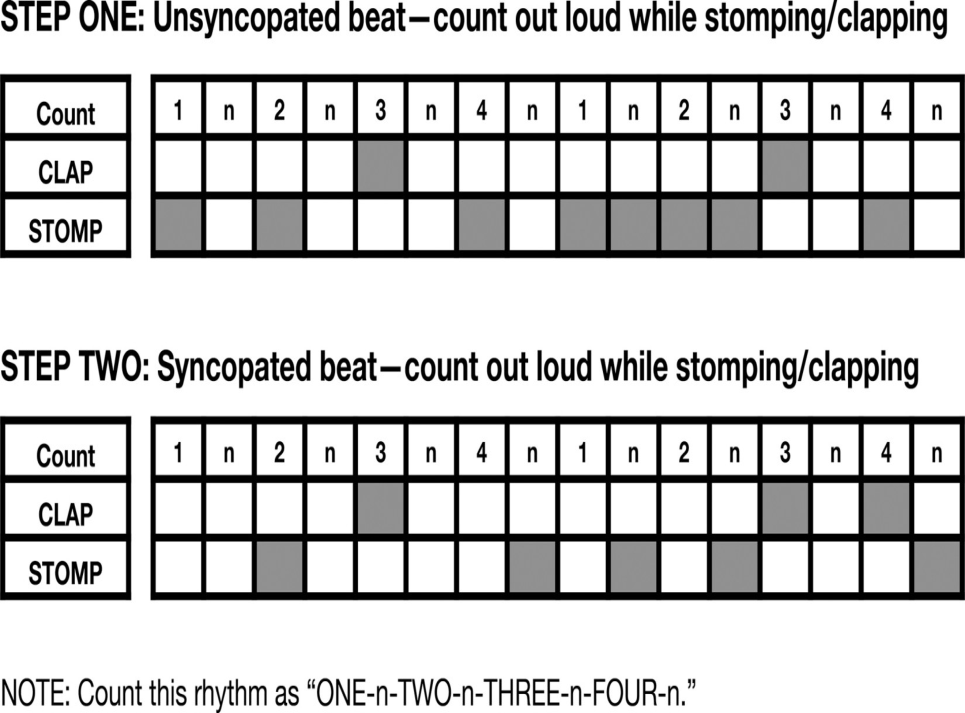
Syncopation imported the surprise of polyrhythm into the monorhythms of North American music without the polyrhythm itself. The pulse was counted in twos, but the events often happened in the places where a superimposed pulse of threes might put them. Syncopation was the ghost of polyrhythm, the spirit of Africa still following its progeny through time and space, through slavery to emancipation and beyond.
African Americans at the turn of the twentieth century didn’t call it syncopation, they called it ragging . To “rag” a tune was to mess around with where you put notes while holding the pulse. As pianos became a feature of middle-class American culture, African American pianists applied their rhythmic sensibilities to the instrument. With Scott Joplin’s performance at the Chicago World’s Columbian Exposition in 1893 and the publication of his “Maple Leaf Rag” in 1899, the genre of ragtime was born. This ragged, rolling, disorienting music where notes came in odd places was an expression of cultural freedom, and thus of defiance. Ragtime roiled white America: young people generally greeted the defiance of rhythmic expectation with surprise and delight; older whites recoiled from the disorder. For the next three decades, ragtime became America’s chief popular music, boosting the growth of the fledgling sheet music and record business.
In the bars and bordellos of early-twentieth-century New Orleans, ragtime became the foundation for another genre of music. Jazz , in one sense, was what happened when multiple musicians ragged a tune, separately but simultaneously, a pleasant confluence of cross-purposes. Jazz was also fed by another emerging genre of African American music from the countryside. The blues , by the 1900s, had evolved into a distinct form: a particular harmonic movement and structure, a microtonality that could be achieved only on instruments like the guitar by “bending” strings to try to get to the notes between the notes on the European scale. And though the blues was counted just as European music was—in twos or threes—it, too, showed a ghost of African polyrhythm. The rhythm of the blues had acquired a particular uneven gait. And thus the emergence of jazz and blues did something else: they created an entirely new way—an African American way—of relating to musical time.
In European music, time was expressed, with rare exceptions, as a straight, even pulse. [^2]

What emerged in the United States in the twentieth century was a practice of delaying the arrival of every other beat, creating an uneven, long-short-long-short pulse called swing .

One way to think about swing is that it’s another artifact of polyrhythm. Polyrhythm is what happens when you divide a segment of time into a pulse of twos while dividing that same amount of time into a second, simultaneous pulse of threes.

Swing is, in a way, what happens when you combine those two pulses into one: a segment of time divided into thirds, but playing only the first and third sections, which essentially is playing a pulse of twos … but uneven, or swung .

In practice, however, swing is more complex than this simple math. Some musicians swing a rhythm only slightly, and some more severely. The expressions of long-short vary from performer to performer, an expression of individual, human time; and a reflection of the movement of the human body and a musical tradition wedded to dance.

Swing as a time-feel would permeate blues, jazz, and nearly every American musical genre to follow: from rhythm and blues to country and western, from rock to soul, from funk to disco, from punk and new wave to hip-hop and electronic dance music. Swing time is now an integral part of the American musical expectation, and thus our global musical expectation.
Listening To: The Difference Between Straight and Swung
One of the greatest examples of the difference between straight and swing time occurs in one of the world’s best-loved and widely known classic rock songs: “Bohemian Rhapsody” by Queen.
Begin listening at the 3:40 mark. Freddie Mercury wrote this section as a mock opera, performed as European classical music is, in straight time. We are still in straight time at 3:57 when the chorus sings the words: Beelzebub has a devil put aside for me.
They will repeat the words “for me” two times. By the end of the second repetition, at 4:05, we are in swing time. Do you hear the difference?
In making a sudden switch from opera to rock ’n’ roll, the song not only shifts from straight to swung, it symbolically crosses the Atlantic, making the journey from Europe to America in eight seconds.
Swing signifies the difference between European and African American rhythmic feels. It’s performance based, not scripted or notated. It adopts the unique qualities of the player.
One musician in particular would help to encode swing into jazz, and thus put the time-feel in the center of all American popular music thereafter: Louis Armstrong, who began in New Orleans, then built his reputation and influence in Chicago and New York, where he became the one musician whom everyone tried to emulate. His methods presaged a subgenre of jazz that became America’s youth dance music in the 1930s and ’40s, taking its name from Armstrong’s time-feel: swing . So much of what pop music became, Armstrong established: the improvised solo; the bluesy, bent way of singing and playing; even the archetype of the Black performer “crossing over” to white audiences. But Armstrong’s delaying of time had the greatest influence. Almost every performer in jazz and pop, whether peer or protégé, took something from him: Billie Holiday and Duke Ellington, Bing Crosby and Frank Sinatra. In the Armstrong style, which became the popular style, he sang or played in a devil-may-care fashion, as if he was in no hurry to get where he was going. I’ll get there when I get there. I’ll see you when I see you. It’ll be worth the wait. In jazz, “cool” was manifested by delay and defiance of expectation.
Louis Armstrong’s musical journey north was part of a larger, dire exodus from the American South, as whites enacted laws that segregated Black Americans and stripped them of their franchise, using terror and violence to enforce them. In the Great Migration, from 1915 until the passage of the Civil Rights Act in 1965, around six million Black men, women, and children fled the former Confederate states. The clos- est and safest northern destination for many Black southerners were the cities of the Midwest, one of which offered a particular promise of prosperity.
Edward “Red” Cornish—born January 2, 1903, the son of an Irish American landowner and one of his Black sharecroppers—left Maryland in 1916, alone on a train at the age of thirteen. He arrived in Detroit and found work at the Ford Motor Company.
Two years earlier, Henry Ford had put the word out that he was doubling the company’s minimum wage to five dollars a day. For working men, this was an unbelievable sum. But Ford’s factories, machines that made machines, had an appetite for men. Ford did something else that many of his peers didn’t do: he hired Black workers. His reasons for doing so are as complex and suspect as the man himself: Ford desired a controllable, loyal workforce that would reject unionism and communism.
Fleeing Jim Crow and attracted by the prospect of paying work, Black Americans flooded Detroit, by the hundreds, then by the thousands. In 1920, the Black population was 40,000. By 1930 it was 120,000. In the years after World War II it would more than double again, to 300,000.
The place on the disorderly map where Black Detroiters were compelled to live was a dilapidated neighborhood called Black Bottom—so named for the color of the riverside soil—pushing northward along Hastings Street into a Jewish neighborhood called Paradise Valley. It swelled with tens of thousands of new arrivals crushed into abysmal housing so scarce that it actually cost more to rent there than it did in the white neighborhoods that surrounded it—neighborhoods that had plenty of space to let but none for Black people. The racial animus in Detroit was so vicious that the white citizens created one of the most active KKK chapters in the North, prompting many in Black Bottom to portray Detroit as living “up South.”
Only a few other tiny pockets of Detroit welcomed Black renters and homeowners. One was located on the East Side near 7 Mile Road, on lands once owned by Detroit’s foremost white abolitionist. That man, Shubael Conant, sold his property with the caveat that there could never be any restrictive covenants barring their sale to Black or Jewish people, as was common practice. The neighborhood that grew on those lands became the city’s first Black middle-class district, Conant Gardens. [^3]
“Ford’s,” as Detroiters called the Ford Motor Company, was the single largest employer of Black Americans in the city; Detroit’s Black churches functioned as hiring halls and its ministers were empowered as recruiters. It was the lowest, the dirtiest, and the most dangerous work—most Black men were hired as janitors or in the foundries; and it wasn’t always the five-dollar day promised. But it was enough to support a family.
“Red” Cornish married a pretty girl from Georgia and had children. His daughter Maybeline started a family with a young man, Thomas “Suge” Hayes, who had himself fled Alabama for Detroit the day after his high school graduation in 1948. Suge worked at Ford’s, too, until he found some more nefarious hustles to support five children, including Maybeline’s daughter, Maureen.
And the man who married Maureen Hayes, Dewitt Yancey, worked for Ford almost his entire adult life, even while he struggled to make a career for himself in music—which had become the second industry in Detroit’s burgeoning Black community.
The restaurants, lounges, and hotels of Paradise Valley became vital venues for the development of syncopated and swung music in the city on the strait: jazz and blues; then the blues’ brazen, uptempo child, rhythm and blues. An archipelago of Black churches spawned generations of musicians and singers. The Detroit Public Schools, segregated as they were, provided comprehensive music education. And Detroit, imperfect as it was, fostered Black prosperity, which enabled not only the purchase of musical instruments, but also a worldview that allowed for the pursuit of fulfillment after generations of struggle for survival— a gift paid for by the mothers and fathers of Detroit with sweat and sleeplessness.
Berry Gordy II and his wife, Bertha, followers of Booker T. Washington’s philosophy of self-reliance, opened a grocery store in Black Bottom that bore Washington’s name, and other businesses, too, instilling in their eight children a similar entrepreneurial spirit. “Ber-Berry” was the name of the family fund into which all the Gordys—adults and children— were required to deposit regularly, a modest reserve of capital out of which the children could draw a loan for any venture approved by the family members. In 1959, the Gordys’ son Berry III applied for a loan to start a record company, and after much debate, he was given $800.
During his teenage years on Hastings Street, the junior Gordy caught the fever for jazz and blues, and began writing songs. A job on the Ford line became an opportunity to write them to the rhythms of the machines. Gordy’s songs for Jackie Wilson—“Reet Petite,” “Lonely Teardrops,” and “To Be Loved”—made him a hitmaker. His new record company was a chance to retain his equity and control, its name turning the Detroit penchant for ethnic diminutives—Corktown for the Irish, Poletown for the Polish, Jewtown for the Jews—back around on the motor city itself: Motown.
Operating from a modest two-story house on West Grand Boulevard, Motown became one of the most successful independent record labels in the country and, eventually, the largest Black-owned business in America. Gordy got there by taking a cue from Ford’s moving assembly line. Motown would be a machine, a full-service music manufacturer that plucked artists from Detroit’s Black neighborhoods, matched them with material written by teams of songwriters, produced those records with a crew of peerless musicians, and debated their quality before releasing them. The artists were drilled in manners, dress, dance; their careers managed and tours booked by Motown. Thus Gordy created the modern concept of artist development, and over the years launched the careers of artists like Smokey Robinson, Diana Ross and the Supremes, Mary Wells, Kim Weston, Marvin Gaye, Stevie Wonder, the Temptations, Martha Reeves, and the Jackson 5, as well as songwriting-production teams like Holland-Dozier-Holland. Tens of millions of Motown records sold across the globe, and on each of them, a map—all roads leading to Detroit.
Motown forged a brand of rhythm and blues that combined its musicians’ swinging sophistication with its singers’ church musicality, and executed this blend, called “soul,” with pop form and commercial intent. Gordy’s mottoes for Motown, “Hitsville, U.S.A.” and “The Sound of Young America,” became self-fulfilling prophecies. Motown’s records were hits on the R&B and pop charts in equal measure—so equal that Billboard magazine eliminated its segregated charts for several years due to Motown’s musical subversion, until a British band, the Beatles, invaded the charts with their own riff on Detroit’s musical ideas.
Berry Gordy in some measure became the foremost practitioner of Booker T. Washington’s theories of apolitical Black capitalism as power. Others in Detroit saw the need for a power more explicit. Elijah Poole, renaming himself Elijah Muhammad, founded in Detroit a Black-centric Muslim creed, the Nation of Islam. The churches of Detroit marshaled an army of volunteers and a wave of capital for the Civil Rights movement to overthrow Jim Crow in the South. The dry run for the March on Washington was Detroit’s Walk to Freedom, down Woodward Avenue on a June day in 1963, after which Martin Luther King Jr. auditioned an early version of his “I Have a Dream” speech in front of a crowd of Detroiters. With them came white progressives, politicians, and trade unionists, who had for one reason or another, at this moment, found common cause with Black Americans. As Black Detroit marched America into its future, there was, for a brief moment, a sense that the road ahead was clearing.
A few months after the March on Washington, engineers from Motown dragged recording equipment around the corner from the studios on West Grand Boulevard to the King Solomon Baptist Church, where they taped a speech by the chief spokesperson for Elijah Muhammad’s Nation of Islam. The Michigan-born Malcolm X lampooned the March on Washington as a sellout by “Negro” leaders to white interests seeking to blunt Black grassroots political power.
“You was talking this march talk on Hastings Street!” he boomed— adding, as an aside, “Is Hastings Street still here?”
It wasn’t.
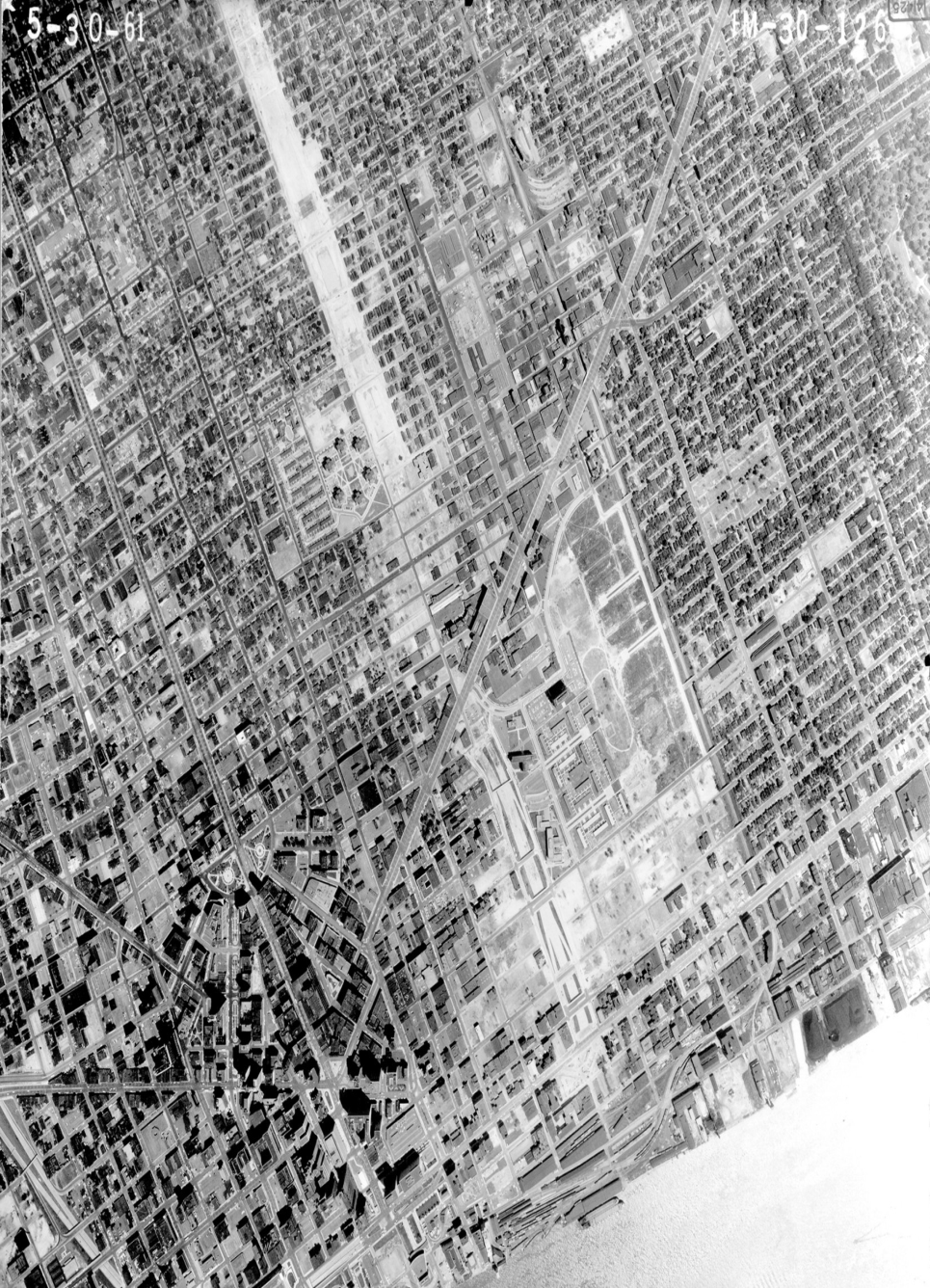
The main artery of Black Detroit had been flattened to build one of several new freeways allowing unimpeded travel from Detroit to the expanding suburbs, which were chewing up land and filling Thomas Jefferson’s square-mile grid boxes with tract housing. In other cities, “urban renewal” projects ended up being little more than “Black removal” programs; but in Detroit’s new order, those plans were executed with explicit racism. Black Bottom and Paradise Valley had produced a community, their streets a matrix for a singular culture. Now Detroit’s chief Black neighborhoods were systematically erased from the map. The organs of Black nightlife were removed to create a new medical center. Streets that traversed Black Bottom and Paradise Valley were spliced, fractured, ruptured, disconnected. Old addresses disappeared under a huge freeway cloverleaf. Years later, the Detroit historian Herb Boyd would write, almost with a shrug: “The altering of neighborhood grids was something most Black Detroiters had grown accustomed to.”
With Black Bottom disappearing, Edward “Red” Cornish had earned enough at Ford’s to move out of the neighborhood and help his daughter Maybeline buy a house on the Far East Side, on Garland Street, into which she, her daughter Maureen, and her other children moved after Suge was sent to prison.
The smashing of Black Detroit, combined with policing by a particularly brutal force, boiled over in 1967 after police raided a West Side after-hours club. In the five-day rebellion that followed, forty-three people died, the National Guard was called up, and over four hundred buildings were destroyed by fire and looting. It marked the beginnings of a power shift. Whites had already been moving north of 8 Mile Road, and now they did so in greater numbers, taking their tax dollars with them. Jobs evaporated with automation and plant closings. Detroit real estate values plummeted, city services dwindled, and crime spread. The neighborhood around Maybeline and Maureen Hayes’s house on Garland emptied: the grocery store, Sylvetti’s Italian Market, the butcher shop, all gone.
The coup de grâce came from Berry Gordy himself when he moved his entire company to Los Angeles in 1972. Motown had become a synonym for Detroit, and it was Detroiters’ pride and joy; but it was a business, not a birthright, owned by a capitalist, albeit a Black one.
The Motown Sound was already on its way out because both music and Detroit had been seized by a new rhythmic development, another African American invention, the first real jump since swing.
Funk , most simply, was a change in rhythm’s center of gravity. The transformation in popular music was drastic, occurring over the course of just a few years.
In the early 1960s, musical time—whether in twos or threes, whether straight or swung—had an overall even keel expressed as a back-and-forth ticktock between the one and the two, the downbeat and the backbeat. Motown music exemplified this evenness. Listen to “My Guy” by Mary Wells from 1964: notice the even back-and-forth between the kick drum on the downbeat and the snare and claps on the backbeat.
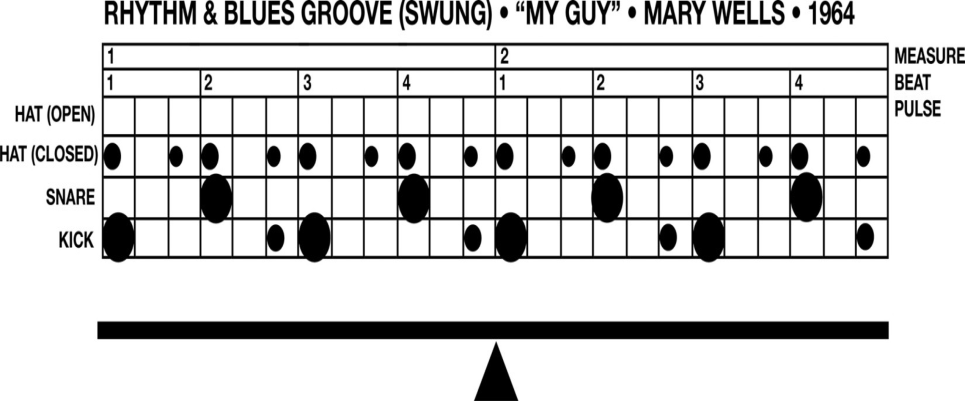
Now listen to “Cold Sweat” by James Brown—a song released only three years later, in 1967—which tilted the emphasis toward the first downbeat, or as Brown called it, the “One.”
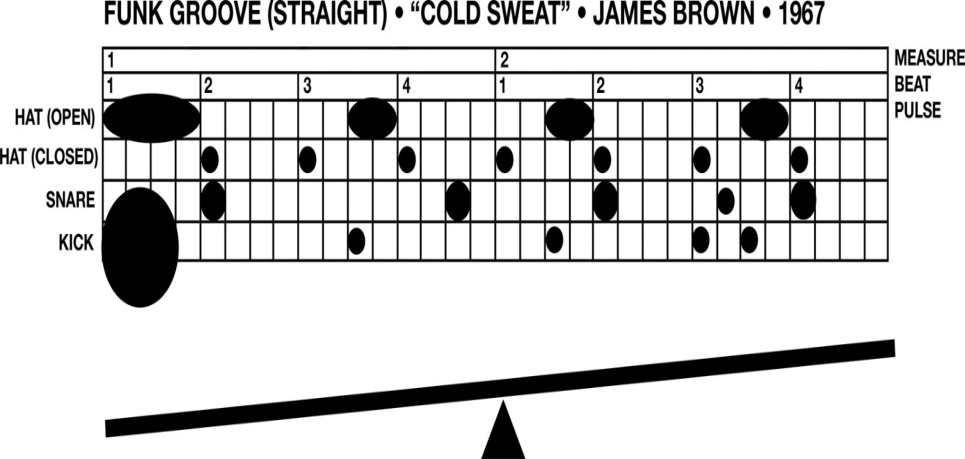
“Cold Sweat” shifted the balance to the One so heavily that the measures after it felt like a suspension, a held breath, building the tension for two whole measures before the next occurrence of the One.

Try it yourself: SHIFTING TO FUNK
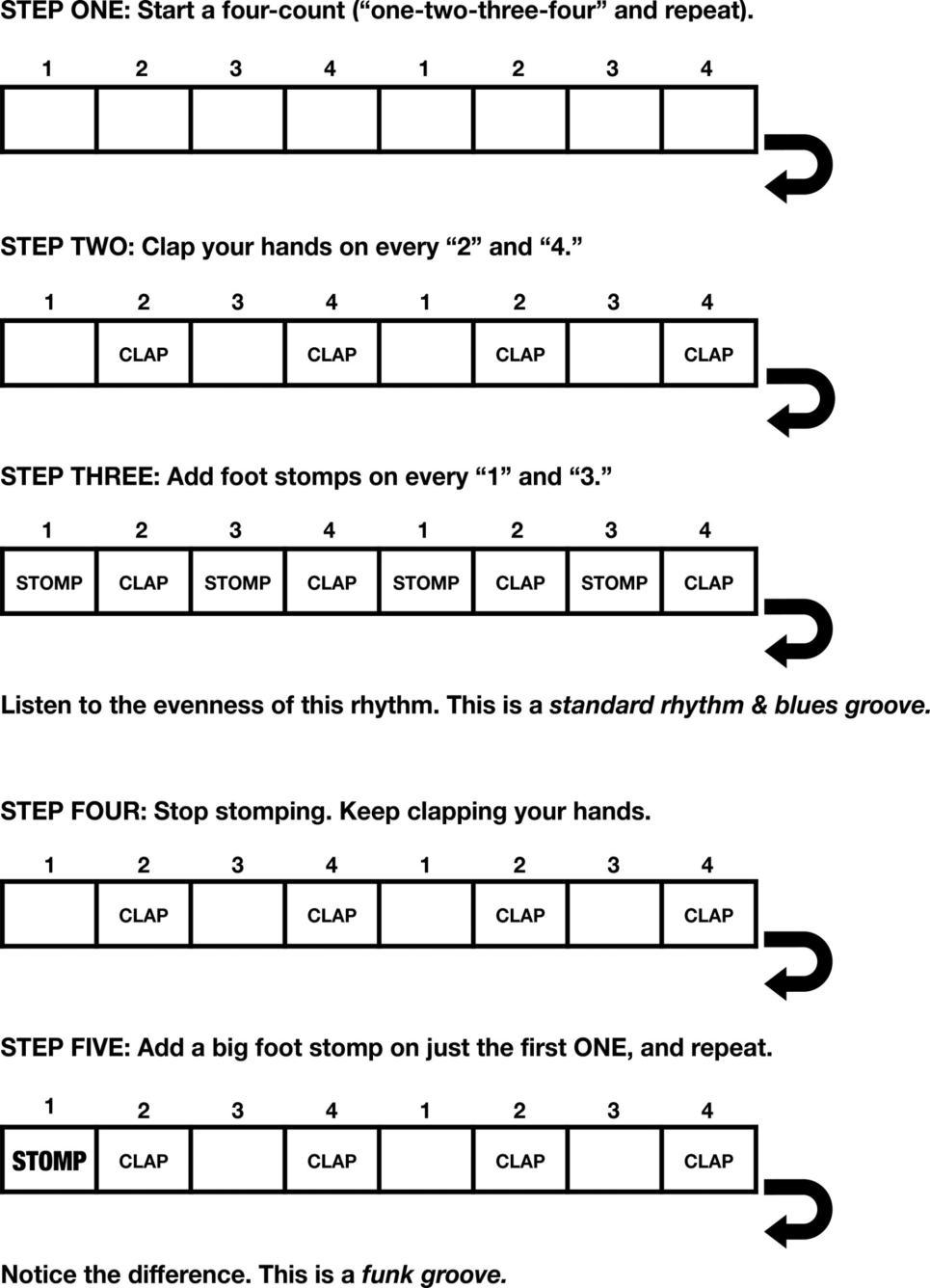
Funk was a rhythmic system of tension and release over time , but also simultaneous tension between some players exercising maximum restraint and others exhibiting maximum expressiveness. Most of all, funk was a science of subverted expectations, syncopation taken to its ultimate destination. With funk, things weren’t always where you thought they’d be. In “Cold Sweat,” the first couple of beats created stability , but the next few kicks and snares came later than expected , increasing instability , a pleasant disorientation and reorientation—with sudden silences creating suspense before the return of the One.
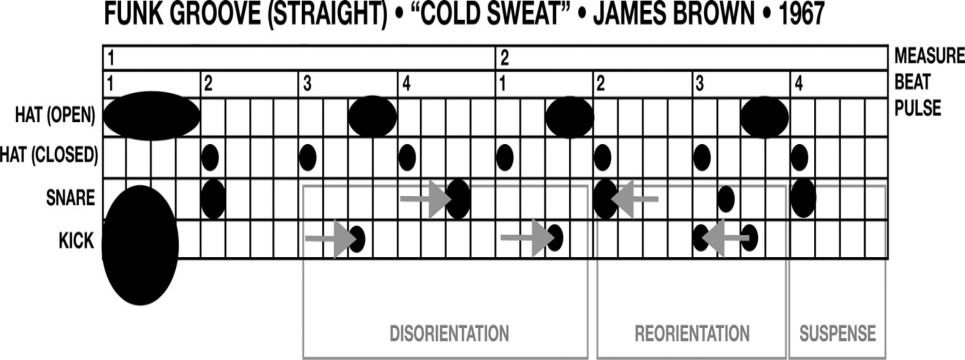
The drums weren’t the only instrument to play with rhythmic expectation, because in funk, every instrument was used as a drum, especially the bass guitar, which also began to take on the melodic work. Funk made the bass line prime.
In the late 1960s into the 1970s, James Brown solidified and codified funk through a series of songs that built out this aesthetic like “Sex Machine” and “Give It Up or Turnit a Loose.” By the end of the 1960s, even Motown’s grooves had changed. Stevie Wonder, for example, had gone from the even-keeled “Uptight (Everything’s Alright)” to one-centric rhythms like “For Once in My Life” and “Signed, Sealed, Delivered I’m Yours.” But funk was a set of ideas that could be heard across all genres. The hard rock band Led Zeppelin’s lead-footed John Bonham was highly influenced by James Brown and his drummers, like Clyde Stubblefield. Almost no corner of global pop went untouched by this particularly American rhythmic idea: reggae, Afrobeat, even country music. And though disco would even out the tilted nature of funk in the 1970s, much of what passed for disco was simply funk by another name. By the end of the decade, funk informed a new genre, hip-hop.
Aside from James Brown, no person was more influential in the growth of funk than George Clinton.
Clinton first hit Detroit in 1962, he and four friends in rumpled suits tumbling out of a souped-up Pontiac Bonneville for an audition with Motown. Clinton and his group, the Parliaments, were literally a barbershop quintet. They cut heads for a living in New Jersey; they drove six hundred miles overnight because they dreamed of cutting records in Detroit.
The Parliaments didn’t leave Motown with a contract. But Clinton found work as a songwriter, and by 1967 he gave the Parliaments their first hit, “(I Wanna) Testify,” on the small Detroit label Revilot. But the Parliaments couldn’t find another hit, and they weren’t made for the slick, choreographed R&B of the Motown era anyway. Instead, they’d create a new one.
The transformation happened in May 1968, during a ten-day residency at the Phelps Lounge at 9006 Oakland Avenue in the decaying north end of Paradise Valley. The Parliaments were third on the bill with several other R&B and soul artists like Jimmy Ruffin, Bettye LaVette, and Carl Carlton. The Parliaments began as one of those class acts in their suits and slickedback hair. But as the days went by, George Clinton and the band became more uninhibited. Clinton stuck his head under a faucet and his process regained its curl. The next evening he came onstage in just a diaper. Some of the band followed, in ever-more-ridiculous costume, from sunglasses and bell-bottoms to duck feet and rooster heads. By the end of those ten days at the Phelps, the Parliaments were gone. Funkadelic had been born.
It would take longer for the sound of the new group to coalesce. The center of gravity came in the form of William “Bootsy” Collins, a veteran of James Brown’s band. Brown had beaten the One into Bootsy’s brain, and the bassist imposed Brown’s ruthless rhythmic rigor on Clinton’s crew of freethinkers, a new order within the disorder. Throughout 1973, their work at United Sound Systems Recording Studios, just seven blocks from Motown’s now-deserted offices, made them Detroit’s innovators. Clinton released the music under two entities: Funkadelic and Parliament— and the bands soon melded in fans’ language into one collective: P-Funk.
In 1975, Parliament released a song called “Chocolate City,” which celebrated a demographic shift taking place in cities all over the United States, Detroit included.
That shift—which saw Black people numbering around half of Detroit’s population of 1.5 million—had already swept a Black man from Black Bottom into the mayor’s office. In late 1973, Coleman Young, a union organizer turned state senator, defeated the ex–police chief who created a program, under the apt acronym STRESS, that had killed nearly two dozen Black men in the previous couple of years.
After Coleman Young won the election, Black Detroit rejoiced as he threw a hex on the city’s criminals, both without and within the police department: “It’s time to leave Detroit. Hit 8 Mile Road!” Our way, or the highway.
Old Detroit was dead. Its creators left behind a broken, disordered maze. New Detroit would be a Black city, a metropolis of the future.
Nothing symbolized the spirit of Detroit’s moment—the embrace of both possibility and impossibility, the sublime and the absurd, both the love and the satirization of Black life—quite like George Clinton’s magnum opus, Mothership Connection , an album that coalesced all the elements of future funk: the creation of outlandish characters like Star Child and the marshaling of synthesizers and electronics, all contained in the Mothership, a warp-drive Cadillac, its occupant a space-age, flamboyant, slang-talking hustler, a mirror of Detroit’s street culture.
The Mothership became a totem of a larger Black American worldview: a cultivated, exuberant dream-sense of the future, spirits both ancient and new, bound with the sciences—math, physics, machines, technology— offering the possibility of flight. In later years, Black scholars would give this aesthetic a name: Afrofuturism. They’d point to the Mothership, and the Phelps, and United Sound Systems, and to Detroit, a place where the past, present, and future all happened simultaneously, as Afrofuturism’s vital incubator. As such, Detroit’s map—a ruptured, offset, conflicted ghost of polyrhythm—could be more than a record of what had been. It might also be a prediction of things that had not yet come to pass.
Star children, aliens on Earth, being born in the shattered grid.